WASHINGTON — Senate Democrats voted down a Republican bill to keep funding the government, putting it on a near certain path to a shutdown after midnight Wednesday for the first time in nearly seven years.
The Senate rejected the legislation as Democrats are making good on their threat to close the government if President Donald Trump and Republicans won’t accede to their health care demands. The 55-45 vote on a bill to extend federal funding for seven weeks fell short of the 60 needed to end a filibuster and pass the legislation.
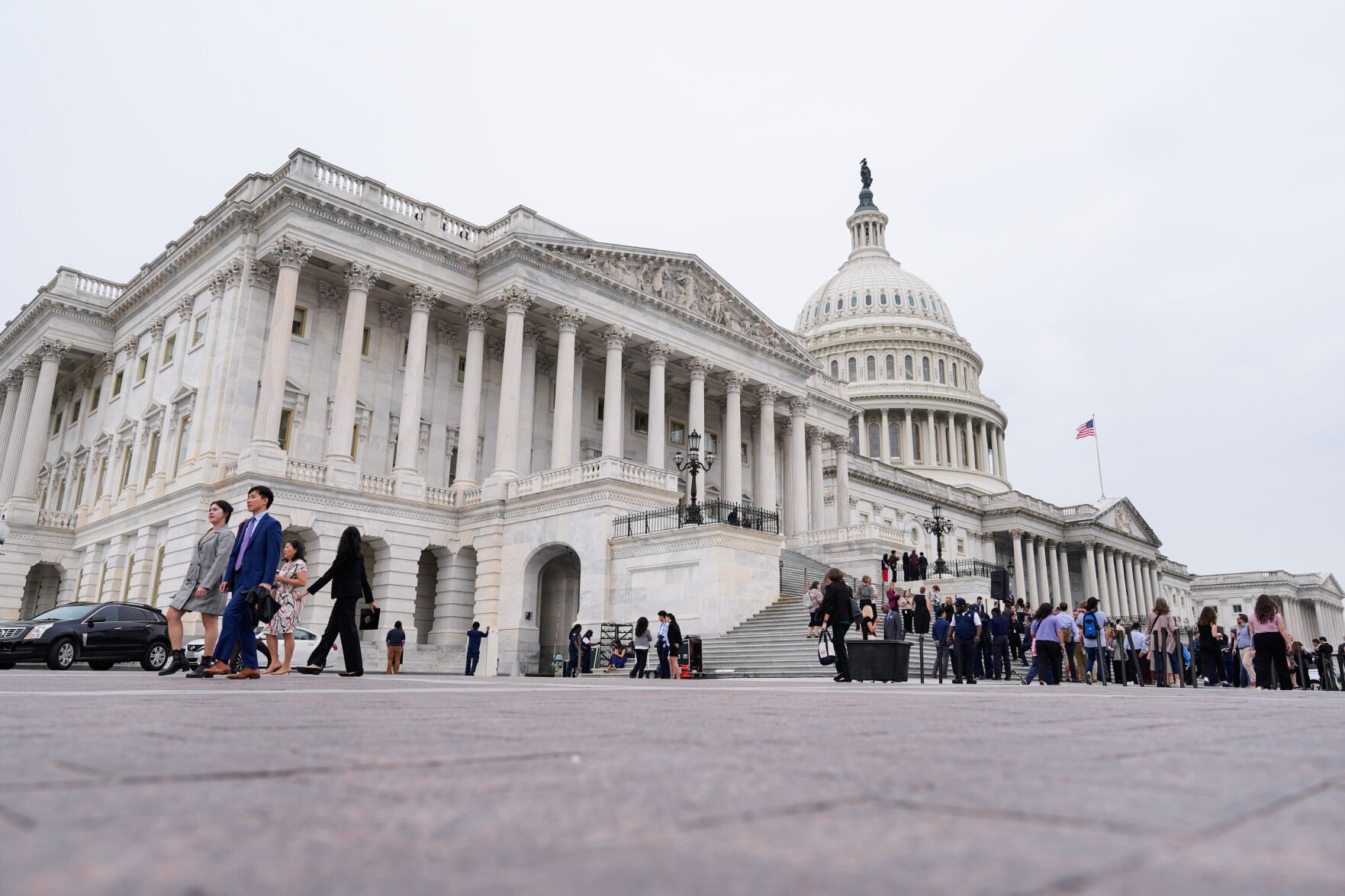
Mariam Zuhaib, Associated Press
The U.S. Capitol is seen after a news conference Tuesday in Washington.
Senate Democratic Leader Chuck Schumer, D-N.Y., said Republicans are trying to “bully” Democrats by refusing to negotiate on an extension of expanded Affordable Care Act tax credits that expire at the end of the year.
“We hope they sit down with us and talk,” Schumer said after the vote. “Otherwise, it’s the Republicans will be driving us straight towards a shutdown tonight at midnight. The American people will blame them for bringing the federal government to a halt.”
The failure of Congress to keep the government open means that hundreds of thousands of federal workers could be furloughed or laid off. After the vote, the White House’s Office of Management and Budget issued a memo saying, “affected agencies should now execute their plans for an orderly shutdown.”
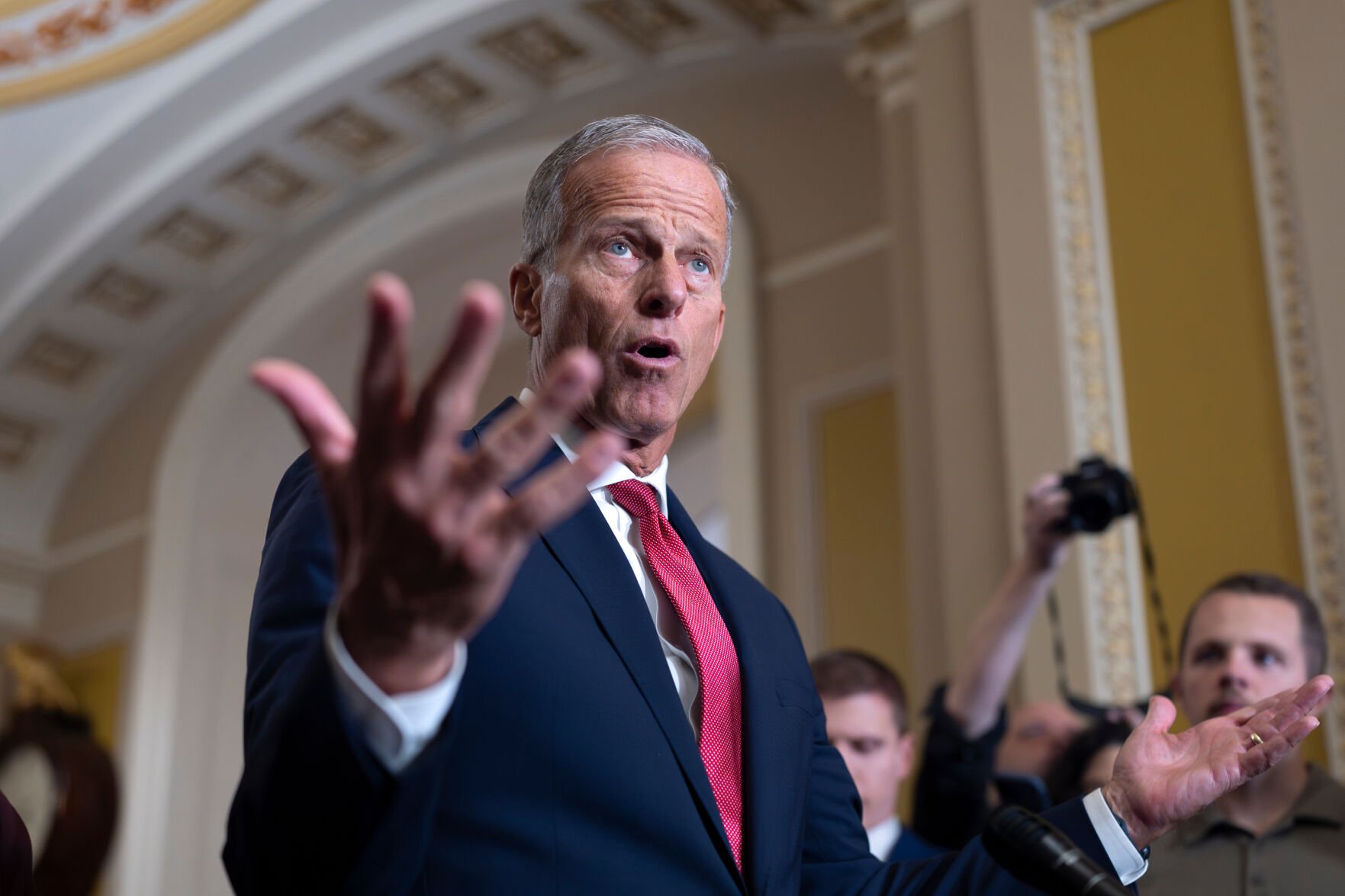
J. Scott Applewhite, Associated Press
Senate Majority Leader John Thune, R-S.D., gestures Tuesday while speaking with reporters at the Capitol in Washington as the government lurches toward a shutdown.
Threatening retribution to Democrats, Trump said Tuesday that a shutdown could include “cutting vast numbers of people out, cutting things that they like, cutting programs that they like.”
Trump and his fellow Republicans said they won’t entertain any changes to the legislation, arguing that it’s a stripped-down, “clean” bill that should be noncontroversial. Senate Majority Leader John Thune said “we can reopen it tomorrow” if enough Democrats break party lines.
The last shutdown was in Trump’s first term, from December 2018 to January 2019, when he demanded that Congress give him money for his U.S.-Mexico border wall. Trump retreated after 35 days — the longest shutdown ever — amid intensifying airport delays and missed paydays for federal workers.
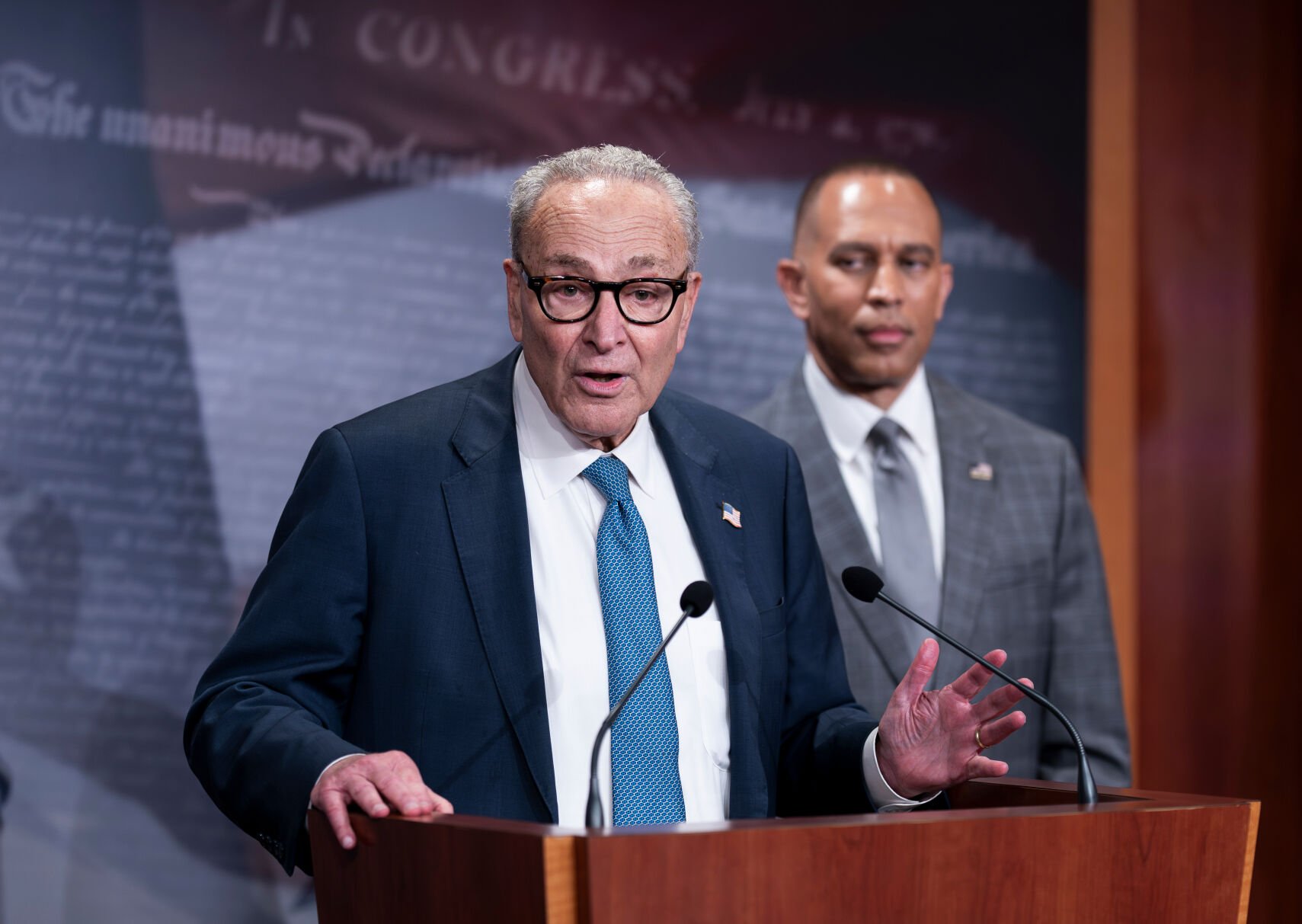
J. Scott Applewhite, Associated Press
Senate Minority Leader Chuck Schumer, D-N.Y., left, and House Minority Leader Hakeem Jeffries, D-N.Y., update reporters Monday at the Capitol in Washington after their meeting with President Donald Trump and Republican leaders on the looming government funding crisis.
Democrats take a stand against Trump, with exceptions
While partisan stalemates over government spending are a frequent occurrence in Washington, the current impasse comes as Democrats see a rare opportunity to use their leverage to achieve policy goals and as their base voters are spoiling for a fight with Trump.
Republicans who hold a 53-47 majority in the Senate needed at least eight votes from Democrats after Republican Sen. Rand Paul of Kentucky opposed the bill.
Democratic Sens. John Fetterman of Pennsylvania and Catherine Cortez Masto of Nevada and Independent Sen. Angus King of Maine voted with Republicans to keep the government open — giving Republicans hope that there might be five more who will eventually come around and help end a shutdown.
After the vote, King warned against “permanent damage” as Trump and his administration threatened mass layoffs.
“Instead of fighting Trump we’re actually empowering him, which is what finally drove my decision,” King said.
Thune predicted Democratic support for the GOP bill will increase “when they realize that this is playing a losing hand.”
Shutdown preparations begin
The stakes are huge for federal workers across the country as the White House told agencies last week that they should consider “a reduction in force” for many federal programs if the government shuts down. That means that workers who are not deemed essential could be fired instead of just furloughed.
Either way, most would not get paid. The nonpartisan Congressional Budget Office estimated in a letter to Iowa Sen. Joni Ernst on Tuesday that about 750,000 federal workers could be furloughed each day once a shutdown begins.
Federal agencies already were preparing.
On the home page of the Department of Housing and Urban Development, a large pop up ad reads, “The Radical Left are going to shut down the government and inflict massive pain on the American people.”
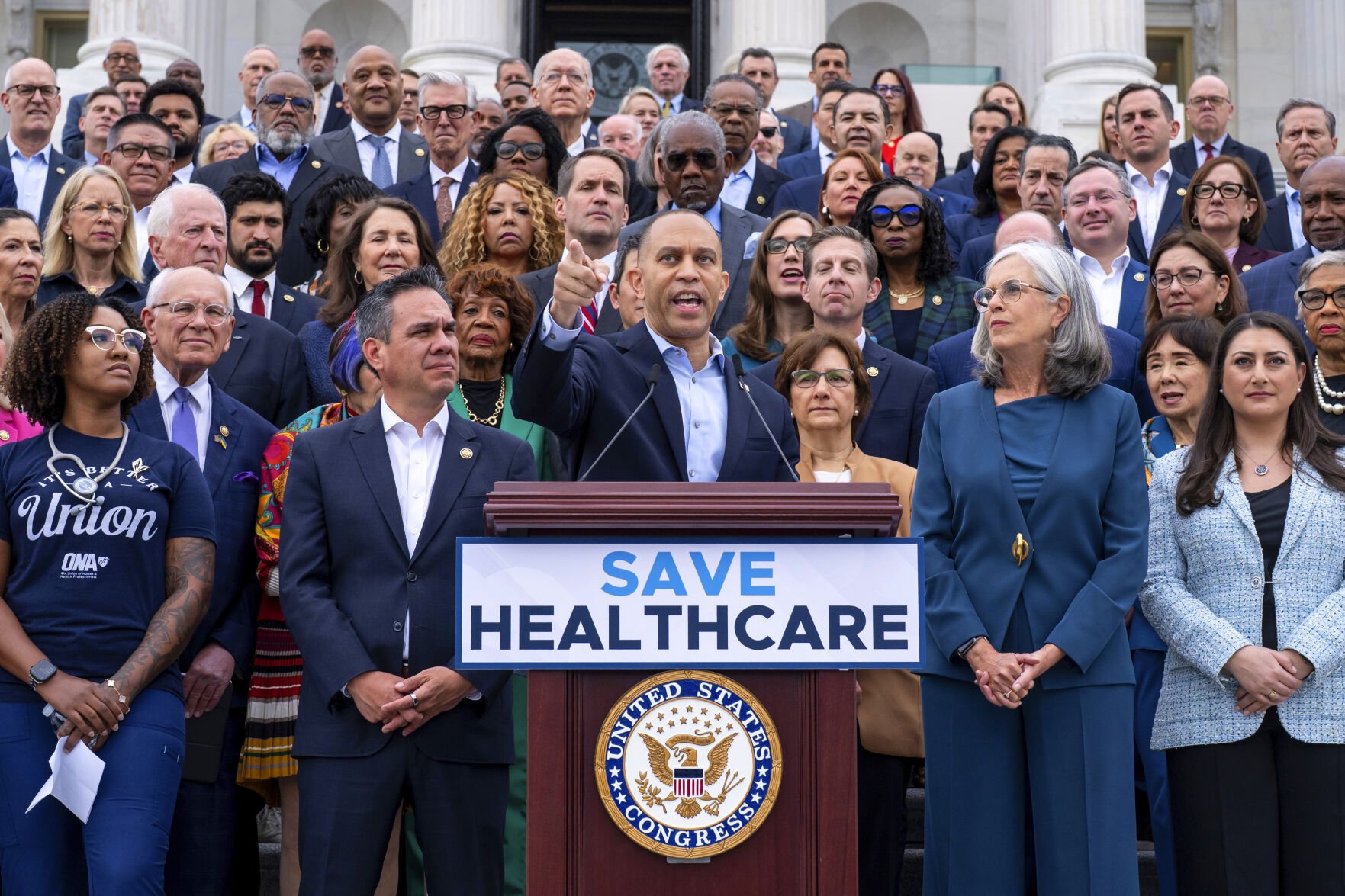
J. Scott Applewhite, Associated Press
House Minority Leader Hakeem Jeffries, D-N.Y., center, flanked by Rep. Pete Aguilar, D-Calif., left, and Rep. Katherine Clark, D-Mass., speaks Tuesday on the steps of the Capitol in Washington, insisting that Republicans include an extension of expiring health care benefits as part of a government funding compromise.
Democrats’ health care asks
Democrats want to negotiate an extension of the health subsidies immediately as people are beginning to receive notices of premium increases for the next year. Millions of people who purchase health insurance through the Affordable Care Act could face higher costs as expanded subsidies first put in place during the COVID-19 pandemic expire.
Democrats have also demanded that Republicans reverse the Medicaid cuts that were enacted as a part of Trump’s “big, beautiful bill” this summer and for the White House to promise it will not move to rescind spending passed by Congress.
“We are not going to support a partisan Republican spending bill that continues to gut the health care of everyday Americans,” House Democratic Leader Hakeem Jeffries said.
Thune pressed Democrats to vote for the funding bill and take up the debate on tax credits later. Some Republicans are open to extending the tax credits, but many are strongly opposed to it.
In rare, pointed back-and-forth with Schumer on the Senate floor Tuesday morning, Thune said Republicans “are happy to fix the ACA issue” and have offered to negotiate with Democrats — if they will vote to keep the government open until Nov. 21.
A critical, and unusual, vote for Democrats
Democrats are in an uncomfortable position for a party that has long denounced shutdowns as pointless and destructive, and it’s unclear how or when a shutdown will end. But party activists and lawmakers have argued that Democrats need to do something to stand up to Trump.
“The level of appeasement that Trump demands never ends,” said Sen. Peter Welch, D-Vt. “We’ve seen that with universities, with law firms, with prosecutors. So is there a point where you just have to stand up to him? I think there is.”
Some groups called for Schumer’s resignation in March after he and nine other Democrats voted to break a filibuster and allow a Republican-led funding bill to advance to a final vote.
Schumer said then that he voted to keep the government open because a shutdown would have made things worse as Trump’s administration was slashing government jobs. He says things have now changed, including the passage this summer of the massive GOP tax cut bill that reduced Medicaid.
Trump’s role in negotiations
A bipartisan meeting at the White House on Monday was Trump’s first with all four leaders in Congress since retaking the White House for his second term. Schumer said the group “had candid, frank discussions” about health care.
However, hours later, Trump posted a fake video of Schumer and House Democratic Leader Hakeem Jeffries taken from footage of their real news conference outside of the White House after the meeting. In the altered video, a voiceover that sounds like Schumer’s voice makes fun of Democrats and Jeffries stands beside him with a cartoon sombrero and mustache. Mexican music plays in the background.
At a news conference on the Capitol steps Tuesday morning, Jeffries said it was a “racist and fake AI video.”
Schumer said that less than a day before a shutdown, Trump was trolling on the internet “like a 10-year-old.”
“It’s only the president who can do this,” Schumer said. “We know he runs the show here.”
___
Associated Press writers Seung Min Kim, Kevin Freking, Matthew Brown, Darlene Superville and Joey Cappelletti in Washington contributed to this report.
-
Government headed to a shutdown after last-ditch vote fails in Senate
Drazen Zigic // Shutterstock
Many ominous ills are likely curable, especially if you have insurance. Without it, patients can find themselves facing life-threatening consequences, as physician Ricardo Nuila, an associate professor of medicine at Baylor College of Medicine in Houston, told Public Health Watch. Nuila had a stage 1 cancer patient who lost his insurance just as he was to receive treatment.
"Without insurance, [my patient] was given the run-around for months by his doctors," Nuila said. By the time his patient was seen at a hospital where he could be treated without insurance, the cancer had already spread.
Delayed diagnosis and care, increasing medical debt, and higher mortality rates are some of the outcomes for uninsured patients. However, 2 in 25 Americans (approximately 26.2 million people) did not have health insurance as of 2023, according to the most recent available Census Bureau data.
While this represents a significant drop from the almost 4 in 25 people uninsured rate in 2010—when the Affordable Care Act was enacted, cutting the rate nearly in half—major coverage gaps remain.
Younger adults, Hispanic or Latino people of any race, foreign-born populations, part-time workers, and residents of states that have not expanded Medicaid were found to be disproportionately uninsured, according to the Census Bureau's 2023 Health Insurance Coverage in the United States report. The rate of Hispanic adults (of any race and aged between 19 and 64) who lacked insurance was about twice the rate for Black adults. The disparities that still exist highlight the pervasiveness of systemic hurdles facing health insurance coverage for many, despite the aims of such a major health care reform.
CheapInsurance.com examined the demographics of the uninsured population in the U.S. using data from the Census Bureau to see who is slipping through the cracks of the American health care system. The American Community Survey was used for historical and state estimates, and estimates for different demographics as of 2023 are from the Current Population Survey.
Editor's note: CheapInsurance.com and Stacker recognize that Hispanic and Latino are not interchangeable terms. The usage of Hispanic and Latino are in accordance with the language of the sources included in this story. Additionally, Census Bureau data was collected using a binary understanding of sex and gender, which excludes important information about gender-diverse professionals. The impact of this exclusion means that this story's coverage may lack nuance related to biased language and nonbinary individuals.

Drazen Zigic // Shutterstock
Many ominous ills are likely curable, especially if you have insurance. Without it, patients can find themselves facing life-threatening consequences, as physician Ricardo Nuila, an associate professor of medicine at Baylor College of Medicine in Houston, told Public Health Watch. Nuila had a stage 1 cancer patient who lost his insurance just as he was to receive treatment.
"Without insurance, [my patient] was given the run-around for months by his doctors," Nuila said. By the time his patient was seen at a hospital where he could be treated without insurance, the cancer had already spread.
Delayed diagnosis and care, increasing medical debt, and higher mortality rates are some of the outcomes for uninsured patients. However, 2 in 25 Americans (approximately 26.2 million people) did not have health insurance as of 2023, according to the most recent available Census Bureau data.
While this represents a significant drop from the almost 4 in 25 people uninsured rate in 2010—when the Affordable Care Act was enacted, cutting the rate nearly in half—major coverage gaps remain.
Younger adults, Hispanic or Latino people of any race, foreign-born populations, part-time workers, and residents of states that have not expanded Medicaid were found to be disproportionately uninsured, according to the Census Bureau's 2023 Health Insurance Coverage in the United States report. The rate of Hispanic adults (of any race and aged between 19 and 64) who lacked insurance was about twice the rate for Black adults. The disparities that still exist highlight the pervasiveness of systemic hurdles facing health insurance coverage for many, despite the aims of such a major health care reform.
CheapInsurance.com examined the demographics of the uninsured population in the U.S. using data from the Census Bureau to see who is slipping through the cracks of the American health care system. The American Community Survey was used for historical and state estimates, and estimates for different demographics as of 2023 are from the Current Population Survey.
Editor's note: CheapInsurance.com and Stacker recognize that Hispanic and Latino are not interchangeable terms. The usage of Hispanic and Latino are in accordance with the language of the sources included in this story. Additionally, Census Bureau data was collected using a binary understanding of sex and gender, which excludes important information about gender-diverse professionals. The impact of this exclusion means that this story's coverage may lack nuance related to biased language and nonbinary individuals.
-
Government headed to a shutdown after last-ditch vote fails in Senate
CheapInsurance.com
The ACA used a combination of carrots and sticks to promote greater health insurance access. The law expanded eligibility for Medicaid for individuals of low income under 65 years old (though not all states opted to participate), and an individual mandate requiring most Americans to have health insurance or pay a penalty.
In 2017, Congress reduced the penalty to $0 through the Tax Cuts and Jobs Act, effectively eliminating it. Then, in 2019, a federal court ruled the individual mandate unconstitutional since it no longer generated revenue. Still, the Supreme Court upheld the ACA in California v. Texas, stating that the plaintiffs lacked standing and could not demonstrate "personal injury fairly traceable to the defendant's allegedly unlawful conduct." If the case went further to invalidate the mandate, it would have opened up the potential for the rest of ACA to be questioned and even dismantled, MaryBeth Musumeci, then associate director of KFF's Program on Medicaid and the Uninsured, explained in an article published in 2020.
The implementation of ACA prompted a significant increase in health insurance coverage rates. By 2023, just 1 in 13 Americans lacked coverage, compared to 1 in 6 pre-ACA. However, coverage is still not equal across the board, and Americans in the lower socioeconomic categories continue to be the most uninsured in the country.
CheapInsurance.com
The ACA used a combination of carrots and sticks to promote greater health insurance access. The law expanded eligibility for Medicaid for individuals of low income under 65 years old (though not all states opted to participate), and an individual mandate requiring most Americans to have health insurance or pay a penalty.
In 2017, Congress reduced the penalty to $0 through the Tax Cuts and Jobs Act, effectively eliminating it. Then, in 2019, a federal court ruled the individual mandate unconstitutional since it no longer generated revenue. Still, the Supreme Court upheld the ACA in California v. Texas, stating that the plaintiffs lacked standing and could not demonstrate "personal injury fairly traceable to the defendant's allegedly unlawful conduct." If the case went further to invalidate the mandate, it would have opened up the potential for the rest of ACA to be questioned and even dismantled, MaryBeth Musumeci, then associate director of KFF's Program on Medicaid and the Uninsured, explained in an article published in 2020.
The implementation of ACA prompted a significant increase in health insurance coverage rates. By 2023, just 1 in 13 Americans lacked coverage, compared to 1 in 6 pre-ACA. However, coverage is still not equal across the board, and Americans in the lower socioeconomic categories continue to be the most uninsured in the country.
-
-
Government headed to a shutdown after last-ditch vote fails in Senate
CheapInsurance.com
Citizenship status is a major factor when it comes to health insurance, according to the Census Bureau data. In 2023, noncitizens had an uninsured rate of 3 in 10 people—almost five times that of the 6.2% rate for citizens and more than four times higher than the 6.7% rate for naturalized citizens.
Employment matters, too, spotlighting features of the American health insurance system, which provides most full-time workers with insurance through an employer. This system most likely leaves unemployed or underemployed Americans without the employer-provided insurance offered to their employed counterparts.
While almost 1 in 10 employed Americans were uninsured in 2023, that rate is closer to 6 in 25 for unemployed individuals. With employer-sponsored insurance being the norm, job loss can mean losing health care entirely.
Breaking down the varying rates of health insurance coverage by age group reveals that young adults between the ages of 26 and 34 face the highest uninsured rate at 13.8%, followed closely by those aged 19 to 25 at 13.1%, according to data from the American Community Survey released in September 2024.
Many lose coverage after aging out of parental plans or having to work jobs without benefits, a trend called the young adult coverage gap. The ACA contains a provision that allows adult children to stay on their parent's health insurance plan until the age of 26, but the provision has not eliminated the gap.
Men are also more likely to be uninsured, at 9%, compared to women, with a 6.9% uninsured rate.
And disparities by income? The wealthier you are, the more likely you are to have insurance. Only 1 in 20 households earning over $100,000 are uninsured, but for families making less than $50,000, that rate more than doubles, according to the Census Bureau.
CheapInsurance.com
Citizenship status is a major factor when it comes to health insurance, according to the Census Bureau data. In 2023, noncitizens had an uninsured rate of 3 in 10 people—almost five times that of the 6.2% rate for citizens and more than four times higher than the 6.7% rate for naturalized citizens.
Employment matters, too, spotlighting features of the American health insurance system, which provides most full-time workers with insurance through an employer. This system most likely leaves unemployed or underemployed Americans without the employer-provided insurance offered to their employed counterparts.
While almost 1 in 10 employed Americans were uninsured in 2023, that rate is closer to 6 in 25 for unemployed individuals. With employer-sponsored insurance being the norm, job loss can mean losing health care entirely.
Breaking down the varying rates of health insurance coverage by age group reveals that young adults between the ages of 26 and 34 face the highest uninsured rate at 13.8%, followed closely by those aged 19 to 25 at 13.1%, according to data from the American Community Survey released in September 2024.
Many lose coverage after aging out of parental plans or having to work jobs without benefits, a trend called the young adult coverage gap. The ACA contains a provision that allows adult children to stay on their parent's health insurance plan until the age of 26, but the provision has not eliminated the gap.
Men are also more likely to be uninsured, at 9%, compared to women, with a 6.9% uninsured rate.
And disparities by income? The wealthier you are, the more likely you are to have insurance. Only 1 in 20 households earning over $100,000 are uninsured, but for families making less than $50,000, that rate more than doubles, according to the Census Bureau.
-
Government headed to a shutdown after last-ditch vote fails in Senate
CheapInsurance.com
Insurance coverage also varies sharply by race and ethnicity. In 2023, just 1 in 20 non-Hispanic white and Asian Americans were uninsured, compared to more than 2 in 25 Black Americans and 4 in 25 Hispanic or Latino individuals. American Indian and Alaska Native populations had some of the highest uninsured rates at 183 people out of 1000.
The disparities along racial and ethnic lines demonstrate the persistent structural barriers to health insurance coverage and, more broadly, health care access. Some of these coverage gaps are rooted in historical policies that codified segregation in health care. For example, Black women ages 15 to 44 have been found to have higher rates of unintended pregnancy and abortion care, compared to their white counterparts, according to national data analyzed by the Morehouse School of Public Medicine and published in 2020.
"There are a multitude of reasons, and we don't fully understand what's going on," Christine Dehlendorf, a professor of family and community medicine at the University of California, San Francisco, who specializes in reproductive health research, told The Atlantic on the same finding nearly a decade before. "But ultimately I think it's about structural determinants—economic reasons, issues related to racism, differences in opportunities, differences in social and historical context."
Another notable example of health care segregation was perhaps the 1946 Hill-Burton Act, which modernized health care facilities across the U.S. but also allowed "separate-but-equal" facilities that excluded many Black, Hispanic and Latino, and other non-white workers from the employer-sponsored benefits afforded to white workers. Although Karen Kruse Thomas, staff historian at Johns Hopkins Bloomberg School of Public Health, found in a 2006 study that while the Hill-Burton program drew racial lines, it also provided Black people more access to hospital care.
Going back to the Jim Crow era, research has shown that systemic racism, such as occupational segregation (where one demographic group is overrepresented in a certain job category) and structural barriers to health care, has persisted across generations in ways that perpetuate the disparities we see today.
CheapInsurance.com
Insurance coverage also varies sharply by race and ethnicity. In 2023, just 1 in 20 non-Hispanic white and Asian Americans were uninsured, compared to more than 2 in 25 Black Americans and 4 in 25 Hispanic or Latino individuals. American Indian and Alaska Native populations had some of the highest uninsured rates at 183 people out of 1000.
The disparities along racial and ethnic lines demonstrate the persistent structural barriers to health insurance coverage and, more broadly, health care access. Some of these coverage gaps are rooted in historical policies that codified segregation in health care. For example, Black women ages 15 to 44 have been found to have higher rates of unintended pregnancy and abortion care, compared to their white counterparts, according to national data analyzed by the Morehouse School of Public Medicine and published in 2020.
"There are a multitude of reasons, and we don't fully understand what's going on," Christine Dehlendorf, a professor of family and community medicine at the University of California, San Francisco, who specializes in reproductive health research, told The Atlantic on the same finding nearly a decade before. "But ultimately I think it's about structural determinants—economic reasons, issues related to racism, differences in opportunities, differences in social and historical context."
Another notable example of health care segregation was perhaps the 1946 Hill-Burton Act, which modernized health care facilities across the U.S. but also allowed "separate-but-equal" facilities that excluded many Black, Hispanic and Latino, and other non-white workers from the employer-sponsored benefits afforded to white workers. Although Karen Kruse Thomas, staff historian at Johns Hopkins Bloomberg School of Public Health, found in a 2006 study that while the Hill-Burton program drew racial lines, it also provided Black people more access to hospital care.
Going back to the Jim Crow era, research has shown that systemic racism, such as occupational segregation (where one demographic group is overrepresented in a certain job category) and structural barriers to health care, has persisted across generations in ways that perpetuate the disparities we see today.
-
-
Government headed to a shutdown after last-ditch vote fails in Senate
CheapInsurance.com
The higher a person's education level, the more likely they are to have insurance. Among individuals without a high school diploma, 20.7%—more than 1 in 5 people—were uninsured. That is nearly six times the close to 3.5%, or 1 in 25 uninsured ratio, among those with a bachelor's degree or higher.
And even high school graduates, as well as those with only some college, see significant gaps, with uninsured rates of 10.8% and 7.1%, respectively.
CheapInsurance.com
The higher a person's education level, the more likely they are to have insurance. Among individuals without a high school diploma, 20.7%—more than 1 in 5 people—were uninsured. That is nearly six times the close to 3.5%, or 1 in 25 uninsured ratio, among those with a bachelor's degree or higher.
And even high school graduates, as well as those with only some college, see significant gaps, with uninsured rates of 10.8% and 7.1%, respectively.
-
Government headed to a shutdown after last-ditch vote fails in Senate
CheapInsurance.com
State policy plays a role in coverage too. States that took advantage of the ACA's Medicaid expansion provision now have lower uninsured rates, and the uninsured rate has fallen even more in those states since the law's passage.
In 2023, Census Bureau data shows that the uninsured rate was 6 in 100 people in states that expanded Medicaid, compared to close to 12 in 100 people in those states that did not. Texas, one of the states that chose not to adopt the Medicaid expansion, leads the nation with the highest uninsured rate, at over 16 people out of 100. The decision not to adopt the Medicaid expansion was concentrated in Southern states, where the highest uninsured rates are also found.
While the ACA allowed states to expand Medicaid and lower income thresholds for eligibility, states that opted out left millions without the affordable plans covered by Medicaid. The result? Sharp differences in coverage across the country.
Story editing by Carren Jao. Copy editing by Sofía Jarrín. Photo selection by Lacy Kerrick.
This story originally appeared on CheapInsurance.com and was produced and distributed in partnership with Stacker Studio.
CheapInsurance.com
State policy plays a role in coverage too. States that took advantage of the ACA's Medicaid expansion provision now have lower uninsured rates, and the uninsured rate has fallen even more in those states since the law's passage.
In 2023, Census Bureau data shows that the uninsured rate was 6 in 100 people in states that expanded Medicaid, compared to close to 12 in 100 people in those states that did not. Texas, one of the states that chose not to adopt the Medicaid expansion, leads the nation with the highest uninsured rate, at over 16 people out of 100. The decision not to adopt the Medicaid expansion was concentrated in Southern states, where the highest uninsured rates are also found.
While the ACA allowed states to expand Medicaid and lower income thresholds for eligibility, states that opted out left millions without the affordable plans covered by Medicaid. The result? Sharp differences in coverage across the country.
Story editing by Carren Jao. Copy editing by Sofía Jarrín. Photo selection by Lacy Kerrick.
This story originally appeared on CheapInsurance.com and was produced and distributed in partnership with Stacker Studio.
